High Cyanuric Acid Explained: How to Lower CYA in Your Pool
Quick answer: The only reliable way to lower cyanuric acid in a pool is to replace some water with fresh water, because cyanuric acid does not break down or get used up like chlorine does. For most pools, dropping CYA from 100 ppm to a healthy 30–50 ppm means replacing about half the water. To stop it from…
Need help with your pool?

Table of Contents
Related Posts
Salt Water Pool Benefits: Should You Convert Your Pool?
Pool Skimming vs. Vacuuming: The Best Methods for a Cleaner, Healthier Pool
Algae Prevention in Georgia Pools: Local Strategies for Cleaner, Healthier Water
When to Open Your Pool in Georgia: A Local Climate Guide for Residential & Commercial Owners
Quick answer: The only reliable way to lower cyanuric acid in a pool is to replace some water with fresh water, because cyanuric acid does not break down or get used up like chlorine does. For most pools, dropping CYA from 100 ppm to a healthy 30–50 ppm means replacing about half the water. To stop it from climbing back, reduce chlorine-tablet use or switch to a saltwater chlorine system.
Key takeaways
- Ideal cyanuric acid (CYA) for most residential pools is 30–50 ppm. Health codes cap it at 90–100 ppm.
- High CYA weakens chlorine. The more CYA you have, the higher the free chlorine level you must hold to keep the same sanitizing power.
- You can’t filter or chemically “use up” CYA. The only way to lower it is to dilute the pool with fresh water (a partial drain & refill).
- Chlorine tablets are the root cause. Every trichlor tablet adds stabilizer that stays behind.
- A salt system is the long-term fix because it makes chlorine for a fraction of the price of dry chlorine, without adding more CYA.
If Sunset Pool Solutions Team sent you this page, your pool’s water test likely came back with a high cyanuric acid level. This guide explains what that means in plain English, what it’s costing you, and the two ways we fix it.
What is cyanuric acid (CYA) in a pool?
Cyanuric acid — also called stabilizer or conditioner — is a chemical that protects chlorine from sunlight. The easiest way to picture it: CYA is sunscreen for chlorine. Without any stabilizer, the sun’s UV rays burn off most of your free chlorine within a couple of hours. A small amount of CYA dramatically slows that loss.
A little protects your chlorine. Too much blocks it from working. As the pool-chemistry community at Trouble Free Pool puts it, cyanuric acid acts like an umbrella for chlorine — helpful in light rain, but a problem when it never lets any sun through.
What should my pool’s cyanuric acid level be?
For most residential pools — including saltwater pools — the ideal cyanuric acid range is 25–40 ppm. Public-health standards set the ceiling: the CDC’s Model Aquatic Health Code recommends a maximum of 90 ppm, and the industry standard ANSI/APSP/PHTA-11 allows up to 100 ppm.
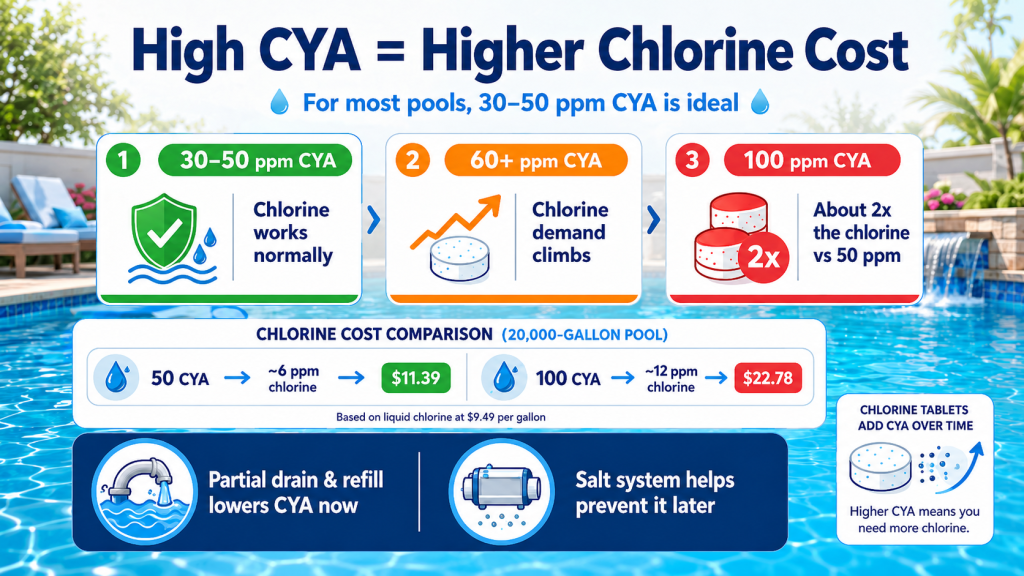
The exact target depends on your pool, your chlorine source, sun exposure, and how the pool is used. But once CYA climbs above about 50 ppm, the free chlorine level you need to keep the water clear starts rising quickly — and that’s where the trouble begins.
Why is high cyanuric acid bad?
High cyanuric acid is a problem because it makes chlorine slower and weaker, so your pool needs much more of it to stay clean. Chlorine is what keeps your water clear, kills bacteria, and stops algae. When CYA is too high, your test can still show chlorine in the water — but a smaller and smaller fraction of it is actually active and working.
The chemistry is well documented. As cyanuric acid rises, the share of free chlorine present as active, germ-killing hypochlorous acid drops — from roughly 3% at 30 ppm CYA to about 1.2% at 80 ppm, according to Trouble Free Pool’s analysis. A 2023 peer-reviewed study in Frontiers in Public Health measured the same effect: as cyanuric acid builds up, the water’s oxidation-reduction potential (a direct measure of sanitizing strength) consistently falls, and it takes longer to kill bacteria. At extreme levels, the study notes a “chlorine lock” effect where adding more chlorine barely helps.
In a backyard pool, that shows up as:
- Cloudy water that won’t clear
- Algae that keeps coming back
- Higher chlorine use and more frequent shocking
- Slower cleanup after a problem
- More money spent on chemicals
How high cyanuric acid costs you more money
High cyanuric acid costs more because it forces you to hold a higher minimum free chlorine level — and to use far more chlorine when you shock. The key principle pool pros use is the FC/CYA ratio: your free chlorine should be about 7.5–10% of your CYA level just to stay sanitary. Double your CYA and you roughly double the chlorine floor you have to maintain.
What this means in dollars
Here is a simple example for a 20,000-gallon pool. These are estimates — your actual numbers depend on pool size, water condition, sunlight, rain, and how much the pool is used.
| CYA level | Free chlorine to hold | Approx. liquid chlorine | Approx. cost |
|---|---|---|---|
| 50 ppm | 6 ppm | ~1.2 gallons | ~$11.39 |
| 100 ppm | 12 ppm | ~2.4 gallons | ~$22.78 |
At 100 ppm CYA you must keep roughly double the free chlorine compared with 50 ppm. And that’s just to maintain the pool. If it turns cloudy or green, the gap gets much bigger, because the shock (or “SLAM”) level is also tied to your CYA.
Important: this is a recurring cost, not a one-time charge. You pay this higher chlorine bill every month that the cyanuric acid stays high, roughly double, month after month, and it spikes again after every cloudy-water or algae episode. Adding more chlorine treats the symptom, not the cause, so the extra cost keeps repeating until the CYA is actually lowered.
| CYA level | Shock chlorine level | Approx. liquid chlorine | Approx. cost |
|---|---|---|---|
| 50 ppm | 20 ppm | ~4 gallons | ~$37.96 |
| 100 ppm | 39 ppm | ~7.8 gallons | ~$74.02 |
At high CYA, clearing algae can cost nearly twice as much in chlorine. That’s why replacing part of the water is often the smarter financial choice: a one-time partial drain & refill resets the chemistry, while buying more chlorine just pays the high-CYA premium over and over with no end in sight.
Pricing example based on liquid chlorine at $9.49 per gallon as of 6/17/26 and a 20,000-gallon pool. Shock levels follow the FC/CYA “SLAM” standard (Trouble Free Pool). Actual chemical needs vary by pool size, water condition, algae level, sunlight, rain, swimmer use, and debris.
How does cyanuric acid get too high?
The cause is chlorine tablets. Most 3-inch tablets are trichlor, which adds two things to your water at once: chlorine and cyanuric acid. The chlorine gets used up by sun, swimmers, rain, and debris — but the cyanuric acid stays behind. Every time more tablets go in, more stabilizer is added, and over months it quietly climbs.
“If you’re servicing my pool, why did this happen?”
It’s a fair question, and the honest answer is: tablets. Pools without a salt system usually rely on tablets to keep chlorine in the water between service visits. Without them, chlorine can drop too low and the pool can turn cloudy or green within 24 hours. The trade-off is that tablets steadily add stabilizer. Once CYA gets too high, normal pool chemicals can’t remove it — the only fix is to replace some of the water. Our weekly service includes CYA testing so we catch the climb early and plan ahead instead of being surprised by it.
How do you lower cyanuric acid in a pool?
You lower cyanuric acid by replacing pool water with fresh water — there is no chemical that safely “removes” it the way you’d remove other imbalances. Cyanuric acid is physically dissolved in the water, so the only way to reduce it is to take some of that water out and add fresh.
The only reliable method is a partial drain and refill. Drain a measured portion of the pool and refill with fresh water. Simple rule: replace 50% of the water and you lower the cyanuric acid by about 50%.
How much water do I need to drain to lower CYA?
The amount of water to replace depends on how far your cyanuric acid is from target. Because dilution is direct, the math is straightforward. To reach a 50 ppm target:
| Current CYA | Target CYA | Approx. water to replace |
|---|---|---|
| 80 ppm | 50 ppm | ~38% |
| 100 ppm | 50 ppm | ~50% |
| 120 ppm | 50 ppm | ~58% |
| 150 ppm | 50 ppm | ~67% |
These are estimates. Sunset Pool Solutions will test your water and recommend the exact amount based on your pool’s actual CYA reading and gallon count.
Important refill note. We test your water and tell you exactly how much to replace, but — due to liability — we do not refill pools ourselves. Refilling is the customer’s responsibility. This protects your property from overfilling, flooding, water damage, and a hose left running unattended.
Is a partial drain a permanent fix?
Not by itself. A partial drain and refill lowers the cyanuric acid that’s in the pool right now, but if trichlor tablets stay your main chlorine source, the CYA will climb again. To actually stop the cycle, you have to change how chlorine gets into the water.
| Option | What it solves |
|---|---|
| Partial drain & refill | Fixes the current high-CYA problem |
| Salt system | Prevents the problem from coming back |
| Liquid chlorine | Adds chlorine without adding CYA |
Will a saltwater system stop high cyanuric acid?
A saltwater system is the best long-term fix for recurring high CYA because it makes its own chlorine without adding stabilizer. A salt chlorine generator turns dissolved salt into chlorine on demand, so your pool produces a steady supply instead of leaning on tablets. A saltwater pool still has chlorine — and it still needs some cyanuric acid, kept in that same healthy 30–50 ppm range — but because the generator doesn’t add stabilizer, the runaway buildup stops.
It also saves money over time. A salt generator makes chlorine from inexpensive salt for a fraction of the price of buying tablets or liquid chlorine — many pool owners cut their ongoing chlorine cost by more than half, so the system gradually pays for itself.
For most pools that keep hitting high CYA, the smartest plan is two steps: lower the current cyanuric acid with a partial drain and refill, then prevent it from returning by cutting tablet use or installing a salt system. Learn about our saltwater system installation.
The bottom line
Cyanuric acid isn’t bad — your pool needs some. But for most pools the healthy range is 30–50 ppm, and once it climbs past about 60 ppm you need much more chlorine to keep the water clear, which means higher costs and more cloudy-water and algae headaches. The short-term fix is a partial drain and refill. The long-term fix is reducing tablet use, usually with a salt system or liquid chlorine.
At Sunset Pool Solutions, the goal is simple: get your chlorine working properly again, stop the recurring algae, and cut the money wasted on chemicals. Clear water. Safer swimming. Fewer recurring problems.
Frequently asked questions
What is the ideal cyanuric acid level for a pool?
For most residential pools — including saltwater pools — 30–50 ppm is ideal. Health standards set the maximum at 90 ppm (CDC Model Aquatic Health Code) to 100 ppm (ANSI/APSP/PHTA-11). Above roughly 60 ppm, your chlorine demand starts rising noticeably.
Can you lower cyanuric acid without draining the pool?
No. Cyanuric acid is dissolved in the water and isn’t removed by filters, tablets, or any normal pool chemical. The only reliable way to lower it is to replace some of the water with fresh water — a partial drain and refill. That’s why catching high CYA early matters: the less it has climbed, the less water you need to replace.
How much water do I drain to lower CYA from 100 to 50 ppm?
About 50%. Dilution is direct: replacing half the water lowers cyanuric acid by roughly half. To go from 80 to 50 ppm you’d replace about 38%; from 150 to 50 ppm, about 67%. We test your water and calculate the exact amount for your pool’s size and reading.
Why does my pool test for chlorine but still turn green?
High cyanuric acid is the usual reason. When CYA is too high, much of your free chlorine is “locked” and inactive, so the test shows chlorine but it can’t kill algae fast enough. A 2023 study in Frontiers in Public Health confirmed that sanitizing strength drops as CYA rises. Lowering CYA restores chlorine’s punch.
Do chlorine tablets raise cyanuric acid?
Yes. Standard 3-inch trichlor tablets add cyanuric acid every time they dissolve. The chlorine gets used up, but the stabilizer stays in the water and accumulates over the season. This is the most common cause of high CYA, and it’s why a salt system — which adds no stabilizer — prevents the buildup.
Need help fixing high cyanuric acid?
Sunset Pool Solutions can test your water, explain your cyanuric acid level, calculate exactly how much water to replace, and recommend the best long-term option for your pool.
Book a Water Test or give us a call: 770-983-6003
Sources
- Trouble Free Pool — The Free Chlorine and Cyanuric Acid Relationship and the FC/CYA Chart.
- Wang et al., Frontiers in Public Health (2023) — Study on the health risk of cyanuric acid in swimming pool water.
- CDC — Model Aquatic Health Code: Cyanuric Acid (90 ppm guidance).
- Orenda Technologies — The CDC’s Limit for Cyanuric Acid and ideal CYA levels.
- ANSI/APSP/PHTA-11 water-quality standard (maximum 100 ppm CYA).